
Power and heatAnswer7 sources
Oil-Filled Radiator Heaters: How Much Electricity Do They Use?
What an oil-filled radiator heater costs to run, worked out from its wattage and EIA's average power price, plus why it heats slowly and how to use it safely.
We earn from qualifying purchases through links on this page. How we make money.
Quick reference5 facts
| Full power | A 1,500 W heater uses 1.5 kWh for each hour at full output |
|---|---|
| Hourly cost at EIA's 2026 average | About 27 cents an hour at 1,500 W and 18.2 cents per kWh (EIA forecast, October 2026) |
| Cost formula (DOE) | Watts x hours / 1,000 = kWh, then kWh x your rate |
| Warm-up (Honeywell manual) | 10 to 15 minutes to reach full heat output |
| Plug (CPSC) | Straight into a wall outlet, never a power strip |
On this page (4 sections)
An oil-filled radiator heater uses as much electricity as its wattage says: a 1,500 W model draws 1.5 kWh for each hour at full power, about 27 cents an hour at EIA’s October 2026 forecast of 18.2 cents per kWh for homes. A thermostat lowers that by switching the element off once the room is warm.
How to work out the running cost from the label
The Department of Energy gives a simple formula for any appliance. Multiply the wattage by the hours you run it, divide by 1,000 to get kilowatt-hours (kWh), then multiply by your electricity rate. The wattage is on the heater’s rating label, and your rate is on your power bill.
The table below uses the U.S. Energy Information Administration’s October 2026 Short-Term Energy Outlook, which forecasts an average residential price of 18.2 cents per kWh for 2026 and 18.7 cents for 2027. Your own rate may be well above or below that, so swap in the number from your bill.
| Setting | Energy per hour | Cost per hour at 18.2 cents | Cost for 8 hours |
|---|---|---|---|
| 1,500 W (full) | 1.5 kWh | About 27 cents | About $2.18 |
| 900 W (if your model has it) | 0.9 kWh | About 16 cents | About $1.31 |
| 600 W (if your model has it) | 0.6 kWh | About 11 cents | About 87 cents |
These are ceilings. With the thermostat set, the element switches off once the room reaches temperature, so real use is usually lower. A plug-in electricity usage meter shows exactly what your heater draws in your room.
Why oil-filled heaters feel cheaper than they are
Every electric resistance heater, oil-filled, ceramic or quartz, turns the electricity it draws into heat. Multnomah County’s energy guidance says these heaters are all 100% efficient and make the same heat per dollar, and that only a heat pump gets more heat from the same electricity. The type of heater changes how the heat reaches you, not how much heat a watt makes.
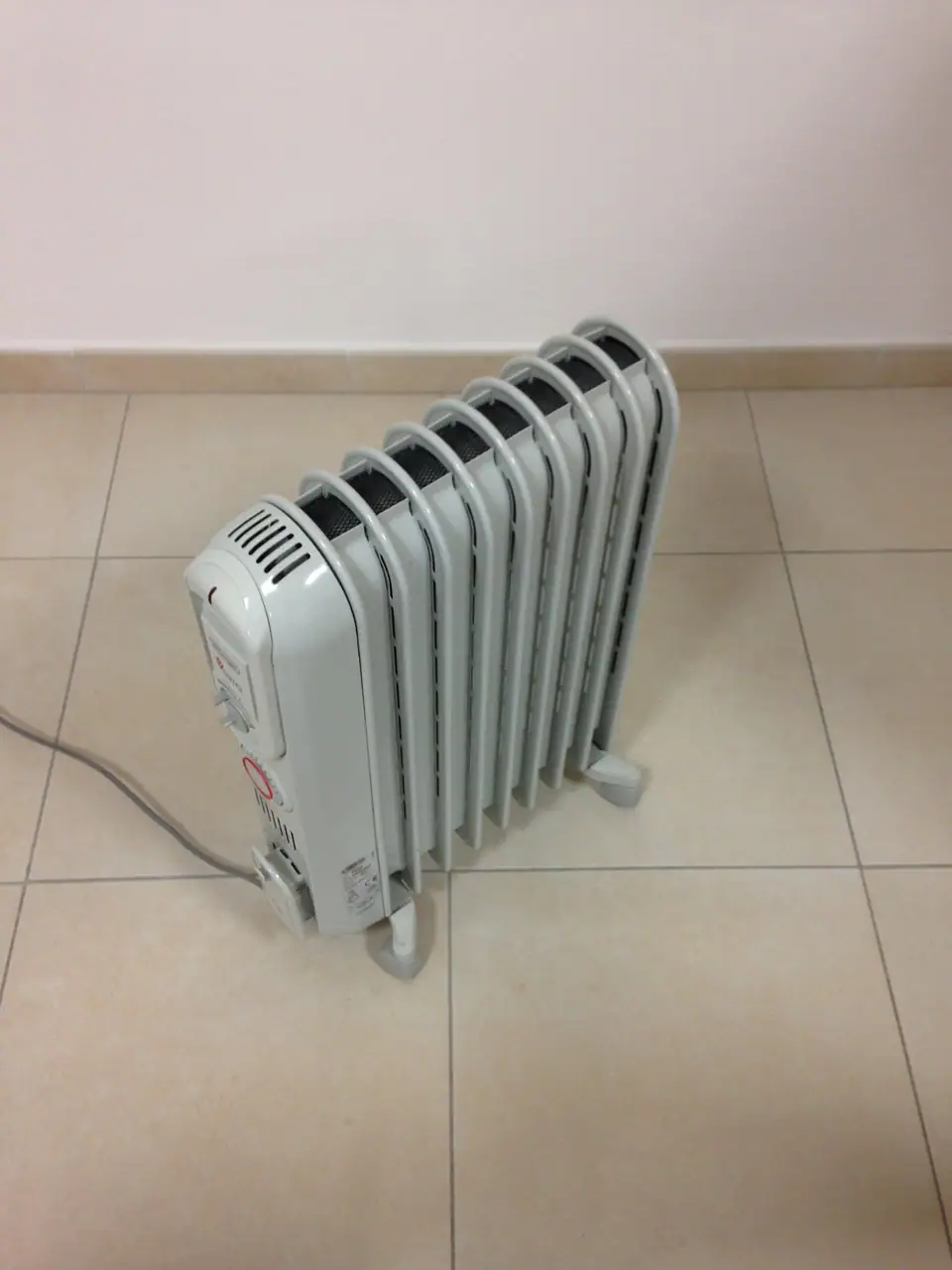
What differs is the feel. Honeywell’s manual for its HZ-789 radiator explains that the heater warms oil sealed inside metal columns, and air passing over the columns carries the heat into the room. It calls this convection heating quiet and gradual, and says to allow 10 to 15 minutes for the heater to reach full output.
That makes an oil-filled heater a good fit for one room you stay in, such as a bedroom in the evening or a home office. For a room you only pop into for a few minutes, that warm-up time works against it.
Cut the bill without cutting comfort
New oil-filled radiator heaters with thermostats
Live listings, shown by eBay
Opens eBay in a new tab. Check condition, seller feedback and returns.
Safe use, from CPSC, NFPA and the manuals
An oil-filled heater has no glowing element on show, but the safety rules for electric space heaters still apply.
- Plug it into the wall. CPSC says to plug space heaters directly into a wall outlet and never use an extension cord or power strip. De’Longhi’s KH19 manual also says extension cables are not to be used with that heater.
- Give it room. CPSC says to keep beds, sofas, curtains, papers and clothes at least 3 feet from the front, sides and rear.
- Keep the cord clear. Honeywell’s manual says not to run the cord under carpeting or cover it with rugs, and to keep it away from traffic areas where someone could trip over it.
- Keep it upright and dry. De’Longhi’s manual says to use the heater only upright, never near showers, bathtubs or sinks, and never to dry laundry on it.
- Turn it off. NFPA says to turn space heaters off when you leave the room or go to bed.
The full list of features to look for, including a testing-lab mark and overheat protection, is in our guide to using space heaters safely in a storm.
What an oil-filled heater cannot do in an outage
An oil-filled heater stops heating when the power does. To run one in an outage you need a generator big enough for 1,500 W plus everything else, connected the safe way. Our portable generator guide covers sizing, generator transfer switches explains the safe connection, and our guide to preventing frozen pipes covers what to do when the house cools down anyway.
Not sure how big a heater the room needs? See how to size a space heater. More ways to keep a home warm are in the heating section.
Frequently asked questions
Is an oil-filled heater cheaper to run than a ceramic heater?
Not per watt. Multnomah County's energy guidance says electric resistance space heaters are all 100% efficient and make the same heat per dollar, so a 1,500 W oil-filled heater and a 1,500 W ceramic heater cost the same per hour at full power. The oil-filled type heats more slowly and quietly, which suits a room you sit in for hours.
How much does it cost to run an oil-filled heater all night?
Use the DOE formula: watts x hours / 1,000 gives kWh, then multiply by your rate. Eight hours at a full 1,500 W is 12 kWh, about $2.18 at the 18.2 cents per kWh that EIA's October 2026 outlook forecasts as the 2026 U.S. home average. A thermostat that cycles the heater off cuts that. NFPA also says to turn space heaters off when you go to bed.
Can I run an oil-filled heater on a generator?
Only a generator sized for it. At 1,500 W the heater is one of the largest loads in a home, and heater safety rules say to plug it straight into a wall outlet, not an extension cord. The setup that keeps both rules is an electrician-installed transfer switch.
Do oil-filled heaters ever need the oil topped up?
No. Honeywell's HZ-789 manual says the oil is permanently sealed and will never need refilling or replacing, and De'Longhi's manual says any repair that means opening the radiator is a job for the maker or an authorized service center.
Sources
- Estimating Appliance and Home Electronic Energy UseU.S. Department of Energy
- Short-Term Energy Outlook, October 2026: Electricity, coal and renewablesU.S. Energy Information Administration
- HZ-789 Oil-Filled Radiator Owner's ManualHoneywell (Kaz)
- KH19 Electric Oil Filled Radiator instructionsDe'Longhi
- What's the most efficient type of electric heater?Multnomah County
- Reducing Fire Hazards for Portable Electric HeatersU.S. Consumer Product Safety Commission
- Electric Portable Space Heater Safety tip sheetNational Fire Protection Association
Filed under Power and heatPart of Winter Heating: Space Heaters and Frozen Pipe Prevention